



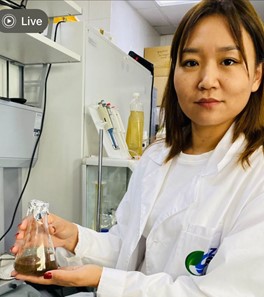
Project Manager: Khozhanepesova Fariza Musabekovna
The aim of the project is to develop and optimize an innovative bioremediation method to improve the efficiency of oil-contaminated soil treatment processes. This method is based on the technology of adsorption immobilization of destructive microorganisms in mineral and plant residues.
An integrated approach to bioremediation: we are developing a new comprehensive method for cleaning oil-contaminated soils in the special conditions of the Mangystau region. This method is based on the use of destructive microorganisms immobilized on waste of mineral and vegetable origin. This approach has never been used in this field, so studying its effectiveness is of great scientific and practical importance.
2.Comparative effectiveness analysis: Our study is aimed at comparing the effectiveness of free and immobilized forms of destructive microorganisms. This analysis makes it possible to accurately assess the effect of immobilization on the bioremediation process, and also helps to identify the advantages and limitations of the method.
Study of the influence of abiotic factors: we study the influence of abiotic factors such as temperature, humidity and salinity on the activity of immobilized microorganisms. This will optimize the bioremediation process in the special climatic and environmental conditions of the Mangystau region.
4.Environmental safety assessment: After bioremediation, we determine the environmental safety of our method by assessing the ecotoxicity of the soil and the viability of plants. This approach allows us to evaluate not only the effectiveness of the method, but also the long-term environmental consequences.
Preparation for practical application: based on the research results, we will develop specific recommendations for the use of this technology on an industrial scale for cleaning oil-contaminated territories of Kazakhstan. This provides a path for our work from a research project to specific applied technologies.