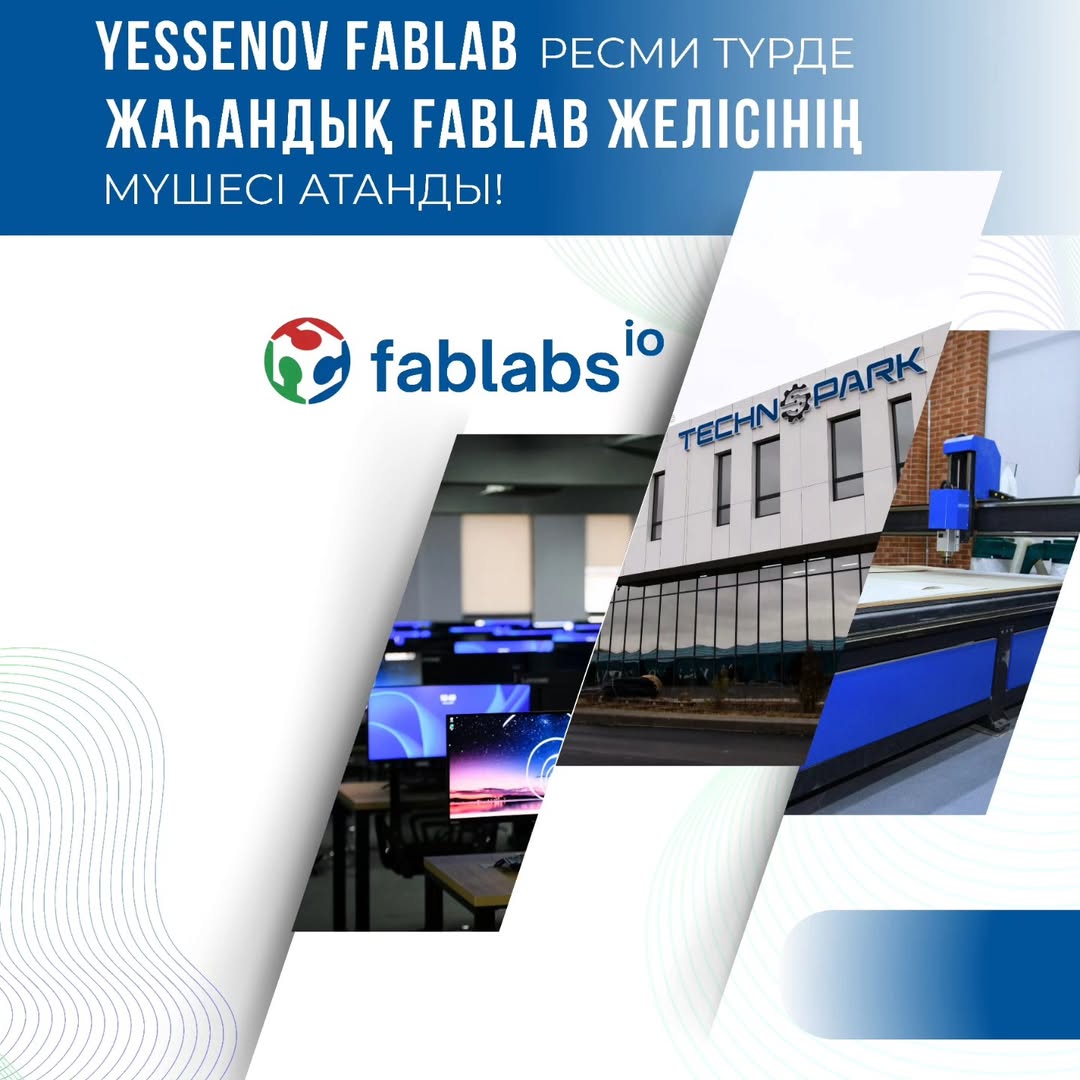
Aktau, Kazakhstan — Yessenov University has reached an important new milestone in its international development by officially receiving Fab Lab Node status within the global Fab Lab network. This recognition places the university in a new category of institutional participation within the worldwide digital fabrication ecosystem and confirms its capacity to serve as a local educational center for the implementation of the Fab Academy program. With this status, the university is now able to admit participants, organize training on its own technopark and Fab Lab infrastructure, and document learning outcomes in accordance with international requirements. As a result, Yessenov University has become the first university in Kazakhstan and the second in the CIS region to obtain Fab Lab Node status.
This achievement builds on the university’s earlier efforts to establish a strong foundation in digital fabrication. Before receiving Fab Lab Node status, YU FabLab had already been created as a dedicated university space for hands-on engineering practice, prototyping, and digital production. It was designed to provide students, faculty members, and engineering professionals with access to modern fabrication tools and applied technological learning. In this way, the Fab Lab was not created as a short-term project, but as a long-term institutional platform intended to strengthen engineering education, support innovation, and encourage creative problem-solving through practical experimentation.
A further important step came on 21 May 2025, when YU FabLab, located at Yessenov University, officially became part of the international Fab Lab network, which connects thousands of digital fabrication laboratories across more than 120 countries. This recognition confirmed that the university’s Fab Lab had reached a level of institutional and technical maturity aligned with international standards. The subsequent award of Fab Lab Node status represents a new stage of growth. It means that Yessenov University is no longer only participating in the global maker movement as a laboratory site, but is now also a recognized platform for delivering structured, internationally connected education in digital fabrication and prototype development.
The significance of this development is closely linked to the Fab Academy, the educational branch of the global Fab Lab movement. Fab Academy is one of the world’s best-known hands-on learning programs in digital fabrication and is associated with the work of Professor Neil Gershenfeld of the Massachusetts Institute of Technology (MIT), one of the key founders of the global Fab Lab concept. Running annually from January to July, the program offers an intensive, practice-based learning model in which participants develop skills across the full cycle of design and production. This includes digital design, operation of fabrication equipment, electronics, embedded systems, and the creation of functional prototypes. International online lectures are combined with laboratory practice and project-based assignments, while participants document their progress through individual electronic portfolios and conclude the program by developing and defending a complete final project.
For Yessenov University, receiving Fab Lab Node status is not an isolated success, but the result of deliberate institutional investment in infrastructure and human capital. In December 2024, the university launched a new technopark with an area of approximately 2,000 square meters, creating a modern space for technology-based learning, prototyping, and innovation. Within this ecosystem, the previously established YU FabLab became one of the most important practical platforms for digital fabrication. Fab Lab-style facilities were further strengthened and subsequently recognized by the international Fab Lab community. The technopark’s core mission is to develop digital fabrication competencies among students and faculty, support engineering projects and startups, create prototypes for the real sector, and contribute to the formation of a sustainable regional innovation ecosystem in the Mangystau region.
The university’s readiness for this new status has also been strengthened by targeted capacity building. Over the past year, two university staff members completed Fab Academy training, helping create the practical and academic foundation needed to develop this direction in a systematic way. Their experience has contributed to the university’s ability to align local training processes with the expectations of the wider global Fab Lab and Fab Academy community.
Following the award of Fab Lab Node status, Yessenov University has already launched its first intake of participants. The first cohort includes highly motivated learners who have begun developing real prototypes using the university’s technopark and Fab Lab facilities. In this way, the university is translating international recognition into practical educational opportunity, giving participants access to a globally connected model of engineering creativity, experimentation, and project-based learning.
The broader importance of this step extends well beyond the university itself. Yessenov University aims to align this initiative with national priorities in digitalization, applied engineering education, and technological entrepreneurship. By strengthening hands-on engineering skills in the regions, supporting innovation-driven startups, and promoting prototype-based solutions for the real economy, YU Fab Node is positioned to become a key platform for nurturing a new generation of engineers, makers, and technology innovators in Kazakhstan.
More broadly, YU Fab Node reflects Yessenov University’s growing role as a university that connects education, innovation, and international collaboration. It demonstrates how regional institutions can become active participants in global technological and educational networks while contributing directly to local development. As the initiative expands, YU Fab Node is expected to become an increasingly important center for creative thinking, scientific experimentation, digital fabrication, and future-oriented skills development in western Kazakhstan and beyond.