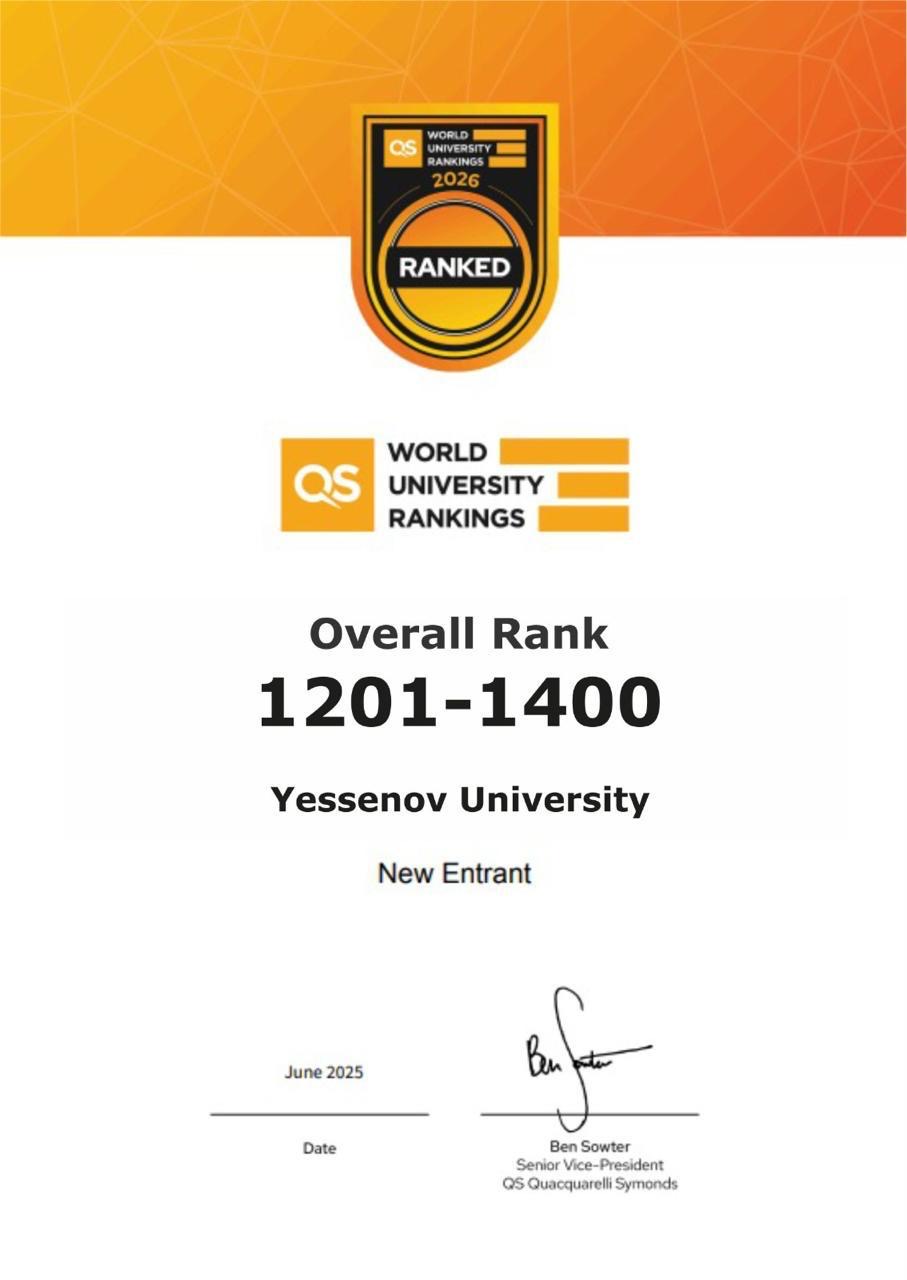
On 19 June 2025, the internationally respected ranking agency QS (Quacquarelli Symonds) released the results of the QS World University Rankings 2026, one of the most influential and widely recognized global rankings in higher education. Out of approximately 30,000 universities worldwide, 8,567 institutions were considered in the ranking process, while only 1,501 universities were ultimately included in the final global list. This year, the ranking also featured 112 new entrant universities, including three from Kazakhstan. These figures highlight both the scale of the ranking and the highly competitive nature of admission into the global table.
For Yessenov University, the publication of the QS World University Rankings 2026 marked a major institutional milestone. The university was included in this global ranking for the first time, placing in the 1201–1400 band worldwide. In addition, among the 20 universities from Kazakhstan that entered the global list, Yessenov University ranked 15th. This is an especially meaningful achievement for a regional university, as it demonstrates not only growing academic visibility, but also the university’s ability to compete within an international higher education environment. Inclusion in such a ranking signals that the university’s progress is being recognized beyond the national level and that its academic development is now being measured against global standards.
This progress can also be understood through the lens of the indicators used by QS. The ranking methodology evaluates universities across areas such as academic reputation, employer reputation, faculty-student ratio, citations per faculty, international faculty, international students, international research network, employment outcomes, and sustainability. While QS does not attribute performance to individual projects, Yessenov University’s institutional development clearly aligns with several of these dimensions. The university’s emphasis on international cooperation, academic mobility, foreign partnerships, and participation in global networks directly supports the logic of internationalization and research connectivity. At the same time, the development of Yessenov Technopark, FabLab, 01Edu, Huawei ICT Academy, and the Kazakhstan-German Institute for Sustainable Engineering (KINI) reflects a strong focus on practice-oriented learning, innovation, digital skills, and graduate readiness, all of which resonate with the broader QS lenses of learning experience, employability, global engagement, and sustainability.
Yessenov University’s entry into the QS ranking should therefore be understood as more than a symbolic success. It is a clear acknowledgment of the university’s academic progress, institutional strengthening, and rising international profile. At the same time, it marks the beginning of a new and strategically important phase in the university’s development. This achievement reflects the tangible results of Yessenov University’s long-term development strategy, which has been built around innovation, international integration, and sustainable development. In this context, inclusion in the ranking serves as evidence that the university’s chosen direction is delivering measurable outcomes and gaining recognition on the global stage.
This historic result is also significant for the broader university community. It affirms the work of the university’s faculty, researchers, leadership, and students, whose collective efforts have contributed to strengthening the institution’s academic standing. More importantly, international recognition of this kind creates a stronger foundation for future growth in research, academic partnerships, student mobility, and institutional reputation. It positions Yessenov University not only as an important educational institution in western Kazakhstan, but also as a university with growing international relevance and ambition.
We warmly congratulate the faculty, staff, and students of Yessenov University on this landmark achievement. This international recognition is a strong indication that the university is moving confidently toward new academic, scientific, and strategic horizons.