



The expanded laboratory tests were carried out within the framework of the AR19677917 project “Development of technologies for the synthesis of granular ammonium sulfate in the conditions of KazAzot JSC, funded by a grant from the Ministry of National Research of the Republic of Kazakhstan for 2023-2025. In order to increase the nitrogen content in fertilizers and reduce their acidic properties, the possibilities of obtaining ammonium sulfite rather than ammonium sulfate, similarly, ammonium nitrite, were considered. The mechanism of the reaction was studied by physico-chemical analysis methods – crystal optical, thermodynamic and XFA. The main plan was to study a safe method for obtaining a mixture of ammonium sulfate and ammonium nitrite. As a result of the research, a more efficient way was proposed: KazAzot JSC buys sulfuric acid to produce granular ammonium sulfate, and in Atyrau region, the issues of sulfur storage and processing are becoming very relevant. The extraction of sulfur is much more than the use. As a result of the research, a method for obtaining a mixture of ammonium sulfate and ammonium nitrite was scientifically substantiated.
– using elemental sulfur or sulfur dioxide;
– reduction of the nitrate ion in solution to the nitrite ion by ammonium sulfite with the regeneration of ammonium sulfate;
2. The production of nitrite helps to increase the nitrogen content of fertilizers and the likelihood of reducing their harmfulness.


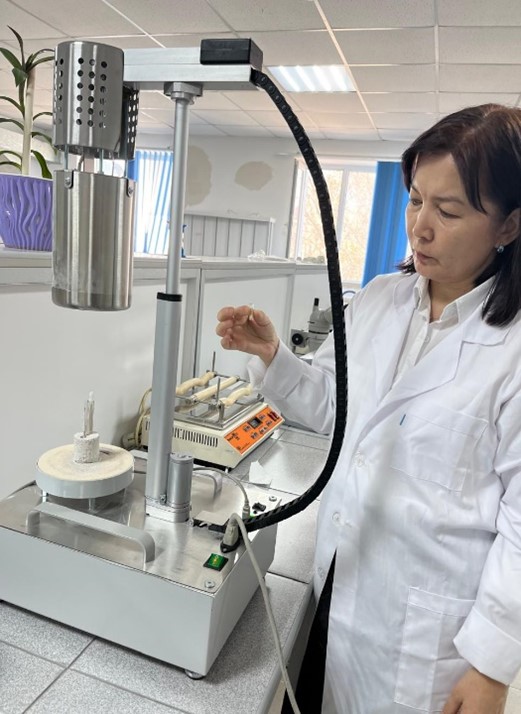
I would like to share the results of a scientific study conducted within the framework of grant funding from the Ministry of Science and Higher Education of the Republic of Kazakhstan for 2023-2025 under the project AR19677917 “Development of technologies for the synthesis of granular ammonium sulfate in the conditions of KazAzot JSC”. We studied complex salts obtained by the interaction of ammonium salts with chloride and potassium carbonate, and also investigated the composition and thermal stability of synthesized samples using X-ray phase and thermal analysis methods. ,
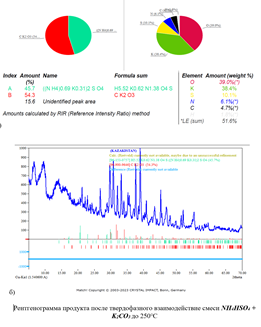
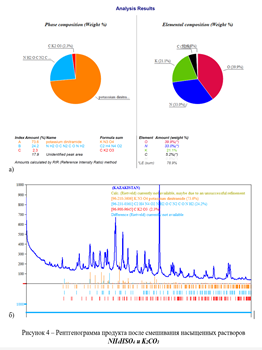
Main results: The composition and thermal stability of the synthesized samples were studied by X-ray phase analysis (XFA) and thermal analysis (DTA/TG). It has been established that the topochemical interaction of ammonium hydrosulfate (Nh₄hso₄) with potassium chloride (KCl) is accompanied by the passage of successive physico-chemical transformations. The interaction begins with the exchange reaction of the formation of potassium hydrosulfate and ammonium chloride. Under dynamic heating the mixture to 350℃ without the exposure according to XRD, the products are amorphous-crystalline phase amidosulfate potassium (KNH₂SO₃) and ammonical sulfate (NH₄)₀.₆₉K₀.₃₁ ) ₂SO₄. Their ratio may vary depending on the maximum temperature and duration of heat treatment, since they are products of partial pyrolysis of potassium hydrosulfate and its simultaneous interaction with ammonium chloride. With the duration of heat treatment and an increase in temperature, the most heat–resistant compound, potassium sulfate, may remain. A noticeable interaction of NH4HSO4 and potassium carbonate (K₂co₃) on the TGA (thermographic analysis) curves begins above the melting point of ammonium hydrosulfate (147°C) with a slight loss of mass – 2.48% of the reaction mixture until reaching a temperature of 300°C. The phases present correspond to the initial potassium carbonate and a relatively thermally stable new product, ammonium potassium sulfate. An increase in temperature leads to its decomposition with the formation of pyrosulfate, then potassium sulfate. The products of the joint dissolution of carbonates of potassium and ammonium water according to XRD, consisted primarily of amorphous phase containing potassium dinitramide (KN₃O₄) and azodicarbonamide (C₂H₄N₄O₂). The results of the study showed that the composition of the final products depends on the ratio of the initial reagents and the synthesis conditions. This opens up new opportunities for further study and practical application of salt reactions.
 I would like to express my deep gratitude to my colleagues for their support and joint work on the project!
Within the framework of Project АР19677917,
“Development of Technologies for the Synthesis of Granulated Ammonium Sulfate under the Conditions of KazAzot JSC”, funded through grant support from the Science Committee of the Ministry of Science and Higher Education of the Republic of Kazakhstan for 2023–2025, large-scale laboratory tests were conducted at KazAzot JSC during January–March of the current year in accordance with the approved plan.
The research activities were aimed at optimizing the technological parameters of ammonium sulfate production. Although the technology itself is well established, certain factors affecting the granulation process and the quality of granules had not been sufficiently considered. During the implementation of sulfuric acid neutralization with gaseous ammonia at KazAzot JSC, an increase in the reaction mass temperature up to 160 °C and agglomeration of the material supplied for granulation were observed. Therefore, studying the effect of temperature on semi-product agglomeration became one of the key objectives of the research.
The large-scale laboratory tests were successfully completed. We express our sincere gratitude to the management and staff of KazAzot JSC for their support and contribution to the effective organization and implementation of the research activities.


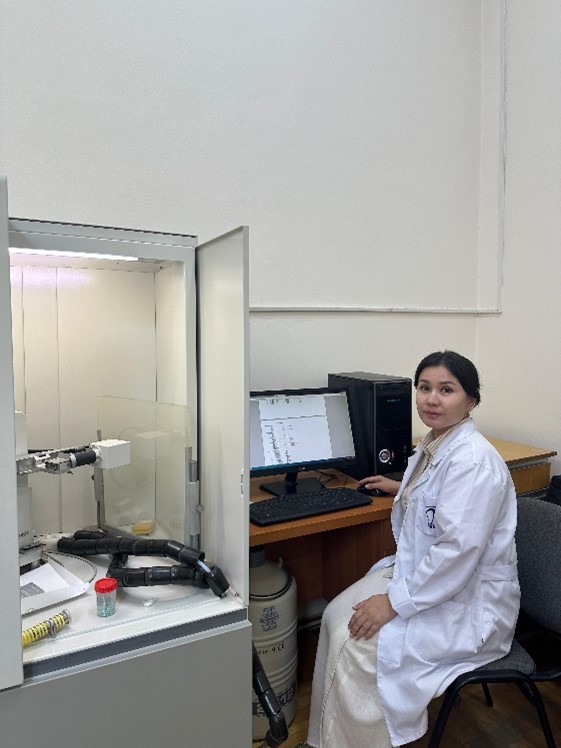
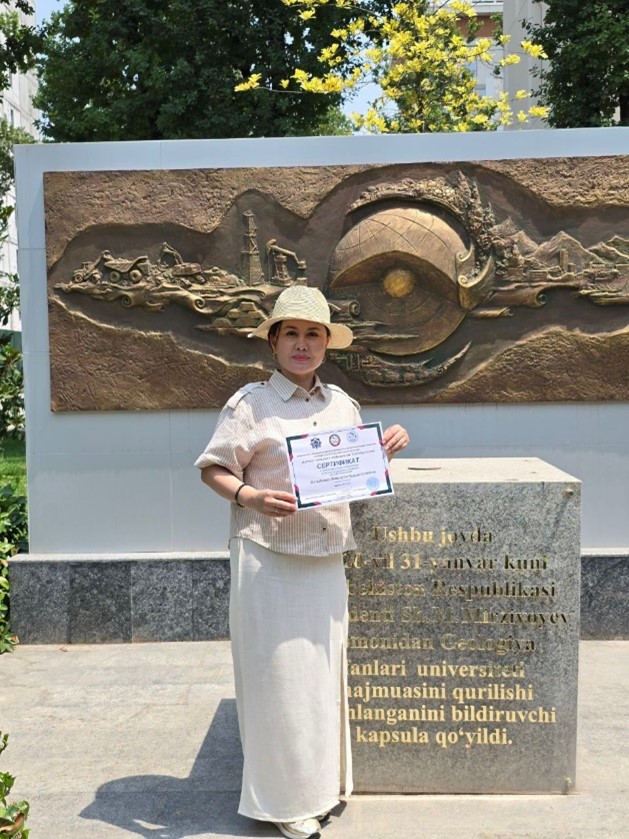
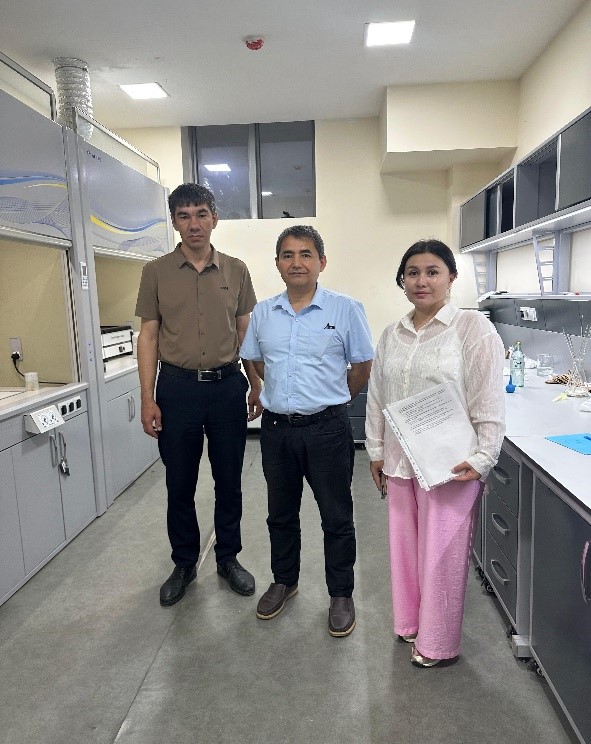
In pursuance of the project “development of technologies for the synthesis of granular ammonium sulfate in the conditions of KazAzot JSC”, 2nd-year doctoral student in the educational program “Ecology” Altybayeva Zhansaule Kydyrgalievna, completed a foreign scientific internship at the Institute of Geology and Geophysics named after H. M. Abdullaev, located in Tashkent, Republic of Uzbekistan. A doctoral student’s internship abroad is a temporary study or research trip for doctoral students (researchers studying under the PhD program), carried out with the aim of conducting research, deepening knowledge and sharing experiences abroad. The main purpose of the internship was to conduct research on the thesis, gain foreign experience, as well as expand scientific partnership. During the internship, the development of modern methods of environmental research, methods of analysis, and the acquisition of laboratory experience. The foreign scientific consultant is Nosir Egamovich Shukurov, Head of the Laboratory of Geochemistry at this scientific center, Candidate of Geological and Mineralogical Sciences, PhD in Ecology.
As a result of the internship:
During the internship, the following laboratory work was performed:
1) MgCO₃ + NH₄HSO₄ — thermogravimetric (DTA, TG) analysis was performed; the temperature rose to 1000 °C.
2) MgCO₃ + (NH₄)₂SO₄ — thermogravimetric (DTA, TG) analysis was performed; the temperature rose to 1000 °C.
3) NH₄HSO₄ + KCl → NH₄KSO₄ — X-ray phase analysis (XFA) of the resulting product was performed.
4) NH₄HSO₄ + K₂CO₃ → NH₄KSO₄ — X-ray phase analysis (XFA) of the resulting product was performed.
The aim is to evaluate the thermal stability and phase composition of the resulting fertilizers.
5) (NH₄)₂SO₄ (KazAzot) — thermogravimetric (DTA, TG) analysis and X-ray phase analysis (XFA) were performed; the temperature rose to 1000 °C.
6) NH₄KCO₃ – X-ray phase analysis (XFA) was performed.
These studies allowed the doctoral student to deeply understand the stability and mechanism of action of fertilizers in accordance with her research work, as well as simulate their interaction
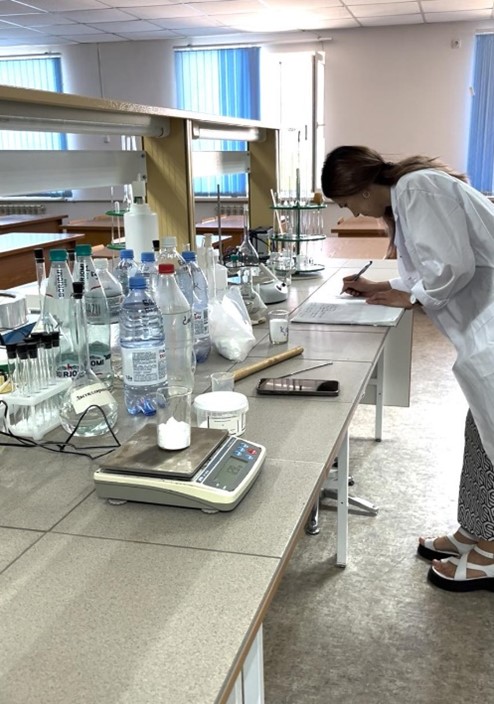
As part of the implementation of scientific, scientific and technical projects under grant funding from the Science Committee of the Ministry of science of the Republic of Kazakhstan for 2023-2025, Yessenov University is carrying out research work in accordance with the calendar plan of the project “development of technologies for the synthesis of granular ammonium sulfate in the conditions of JSC” Kazazot” AP19677917″. It should be noted that this project considers the possibility of improving the classical method and expanding the range and scope of application of products by obtaining ammonium sulfate granules, as well as obtaining ammonium double sulfates. Currently, the mechanism of formation of synthesized granular ammonium bisulfate is being studied by crystalloptic analysis. Microcrystalloscopic analysis is a method of qualitative Microchemical determination of inorganic substances by the formation of a characteristic crystalline precipitate when a small amount of reagents is exposed to one drop of the analyzed solution (about 3-5 ML). The sediment was studied under a microscope in the laboratory of the Department of Ecology and geology with an increase of 40 and 100 times. In this case, the shape, size, mutual arrangement of crystals are studied, in complex cases, some crystallographic and microcrystalloptic constants are additionally determined. The decrease in the specificity of microcrystalloscopic analysis is caused by the influence of many factors to obtain crystals in a strictly defined form. Determining the dependence of crystallization on the listed factors is an urgent problem of this method of analysis. 6 different samples were taken for the study, the main goal was to determine the forms of crystal formation, as well as to study the differences between reagent and synthesized ammonium sulfate from each other, to compare the crystal formation and shapes of granular ammonium sulfate in the dissolved state under Kazazot conditions, to determine how much influence of granular shapes on the degree of According to the plan, research work will continue.


In accordance with the calendar plan, a thermodynamic and derivatographic analysis of the reaction of calcium and magnesium carbonates with ammonium sulfate was carried out. The analysis of the properties of double sulfate hexahydrate – magnesium ammonium disulfate, which begins to lose hydrate water above 70 ° C, which can have a significant positive effect in terms of moisture retention and play the role of drip irrigation in arid climates and supply plants with the necessary components. In this direction, it would be interesting to study the effect of multicomponent ammonium sulfate fertilizers. It is also of interest to study similar ammonium bicarbonate compounds, which may be products of the interaction of ammonium carbonates and sulfates. The conducted research, taking into account the data of the literary analysis, provides a basis for concluding that it is advisable to continue the research in this direction based on the results obtained.
According to the calendar plan for 2024 for the project, the order of experimental work was discussed and agreed:
Experimental parameters for granulation of ammonium bisulfate were determined and preliminary experiments were carried out, by changing the pH of the medium, granules were obtained. Their analysis is carried out in the Kazazot laboratory.


The research team of the scientific project АР19677917,
“Development of Technologies for the Synthesis of Granulated Ammonium Sulfate under the Conditions of KazAzot JSC”, implemented with grant funding from the Ministry of Science and Higher Education of the Republic of Kazakhstan for 2023–2025, discussed the activities to be carried out in accordance with the calendar plan for the second year of the project (2024) and clarified the list of required measures and tasks.
The meeting of the research team was held at KazAzot JSC, which serves as the object of research for this scientific project. During the meeting, specific tasks were assigned related to the production of granulated ammonium sulfate, refinement of technological parameters, identification of types of additives and double salts used for ammonium sulfate crystallization, as well as determination of raw material sources used in these processes.
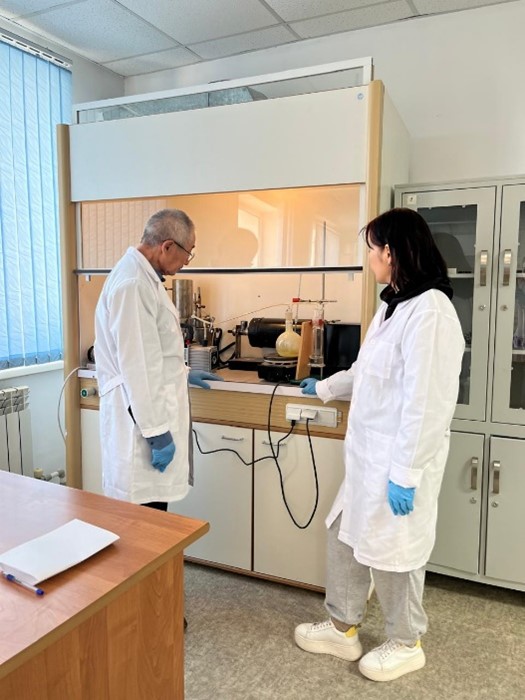
After defining the scope of upcoming work, members of the research team participated in activities related to the commissioning of ammonium sulfate production. They then thoroughly familiarized themselves with the production chain of ammonium sulfate and exchanged views with industrial specialists on improving technological parameters.
As a result of studying the ammonium sulfate production technology, technological process parameters requiring improvement were identified. Issues related to optimizing the process of producing granulated ammonium sulfate and selecting materials suitable for obtaining complex salts were also discussed.
In Almaty, inspection, review, and acceptance procedures were carried out for the manufacturing process of a reactor-crystallizer and a granulator being assembled under a contract with an individual entrepreneur.


Within the framework of the project, in cooperation with members of the research team of the republican state enterprise with the right of economic management, the National Center for Integrated Processing of Mineral Raw Materials of the Republic of Kazakhstan, the synthesis of double salts of ammonium bisulfate was carried out in a coordinated manner (9 samples). The synthesized salts were sent on a contractual basis to Global Save Pharma LLP for thermogravimetric and XRD analyses.
By the decision of the protocol of the meeting of the National Scientific Council under the grant funding competition for scientific and/or scientific-technical projects for 2023–2025, announced by the Science Committee of the Ministry of Science and Higher Education of the Republic of Kazakhstan, the project entitled
“Development of Technologies for the Synthesis of Granulated Ammonium Sulfate under the Conditions of KazAzot JSC”, led by Professor Akmaral Kabylbekovna Serikbayeva of the Department of Ecology and Geology, was selected as a winning project.
As part of the project implementation, the principal researcher of the project — Doctor of Technical Sciences, Professor, and Head of the Physicochemical Laboratory for the Integrated Utilization of Condensed Wastes at the Z. Abishev Institute of Chemistry and Metallurgy, Kalkaman Zhumashuly Zhumashev — paid a working visit. During the visit, a meeting was held with the research team to discuss research activities to be carried out in accordance with the project’s calendar plan. In addition, the research team visited the production facilities of KazAzot JSC, where a program of joint activities was developed.
Overall, the national science funding system is aimed at the comprehensive development of Kazakhstan’s scientific potential, increasing its competitiveness, and enhancing its contribution to the country’s sustainable socio-economic progress. The production of mineral fertilizers remains one of the most in-demand sectors of Kazakhstan’s chemical industry. In the context of competition from Uzbekistan and Russia, improving production efficiency requires not only modernization of existing enterprises and expansion of fertilizer product ranges, but also the development and implementation of advanced technologies, which are among the key objectives of this project.
The project envisages improving classical methods for producing ammonium sulfate granules, as well as expanding the product range and application areas through the synthesis of double ammonium sulfates.
It is expected that the implementation of scientific and scientific-technical activities within the framework of grant funding under Project AP19677917,
“Development of Technologies for the Synthesis of Granulated Ammonium Sulfate under the Conditions of KazAzot JSC”, will yield positive and practically significant results.


